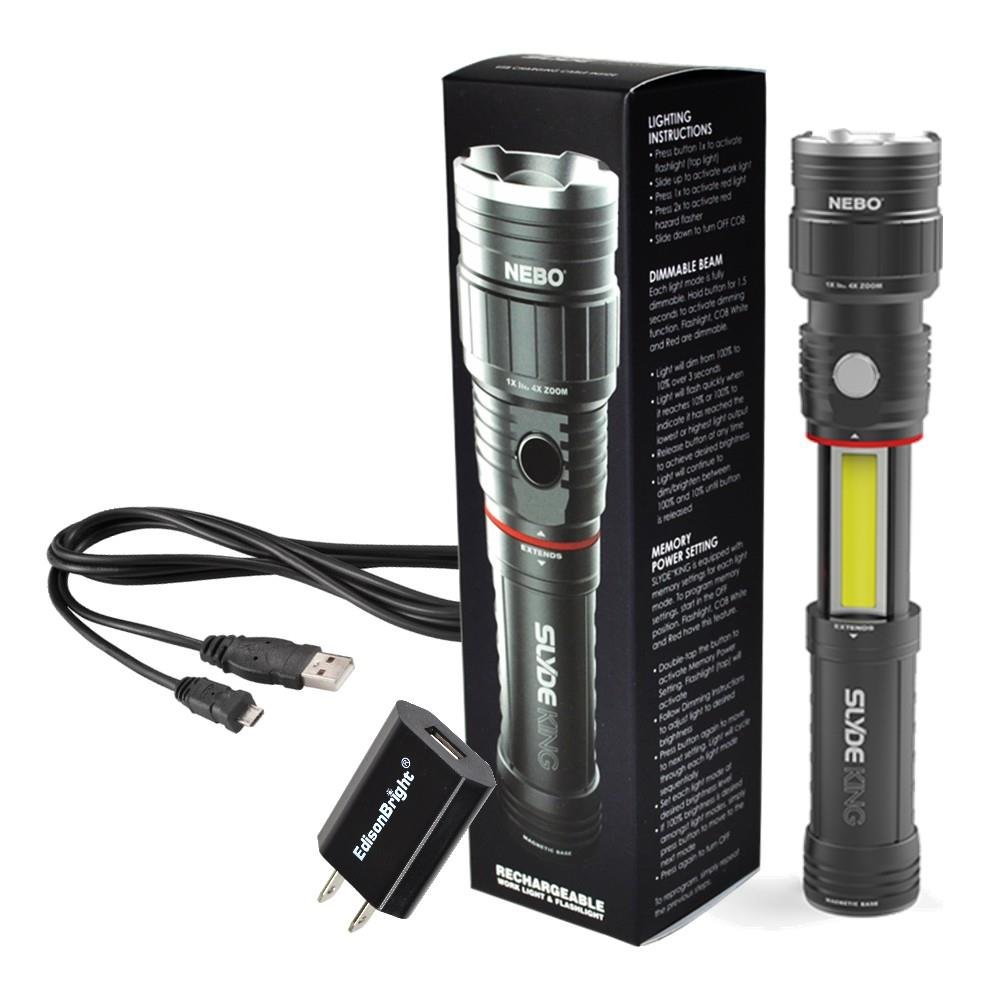
Flashlights have helped me so
much from walking the dog at night to finding things I've dropped. I've bought
so many over the years as my vision changed. I've left the house and realized
my shoes are black when my dress is blue or wore black socks with blue shoes
and pants. My brother bought a great flashlight for my dad who bought the same
one to give my siblings. it's a NEBO Slyde King #6434. My other flashlight is a
LiteAll by Promier. I went to Academy Sports and asked the salesperson for the
brightest flashlight in stock without being too expensive or heavy. They have
four sizes: one small enough for my purse at $15, a small one for my son at
$10, a medium one for home at $40, and a large which I didn't buy at $60. Most
flashlights are LED which doesn't mean they're bright enough for someone with
low vision. Go by the Lumen size to pick what is right for you. I have a 300 and a 320 Lumen.
I haven't posted in awhile due to many reasons but mainly Blogspot changed their home page for bloggers. I can't find anything on my iPad so I can post. Yesterday my husband and I had guest over for supper. We went to Publix for groceries. As we took off down the road we noticed a few street light out. We thought this must have just happened. We entered Publix to out surprise the store was dark. I was explained to us that the lights had been out for 30 minutes. They had a generator so the AC and some lights were on. As we made our way around the store I had my cane out and told my poor husband not to move more than 4 feet away from me. We found most of the items we needed. Did I mention the just rearranged the store so I'm not sure where most things are. The employees were working together to cover the refrigerated and frozen foods. The staff were very friendly asking did we find everything we needed and had flashlights to help. I told my husband I usually have a flashlight in my purse but not today. At the register they were joking about the lights I commented as I folded my cane "Now you now what my world is like". We heard from several friends that their neighborhood were without light but not ours. Today the newspaper reported the outage was due to a squirrel in the transformer.
Last night, I cried out at my TV as I watched the NBC Nightly News story on the upcoming incandescent light bulb phase out. The very first line delivered by the reporter was inaccurate and misleading and I knew it. “At 131 years old, Thomas Edison’s bright idea may be due for a makeover,” said NBC’s Chief Environmental Affairs Correspondent Anne Thompson, “but the government-mandated transition from the incandescent to the compact fluorescent – the CFL – isn’t winning many style points.” “That’s not true,” I hollered at the TV, sending my cat flying off the sofa. You would think I was watching the Superbowl instead of the nightly news by the way I was shouting at my flatscreen. It’s really not true! The federally-mandated phase out of inefficient incandescent light bulbs does not in any way specify that consumers must only buy mercury-laden CFLs. The new energy efficiency standards, set to start in 2012, say we can replace our energy-wasting incandescent bulbs with any lighting technology that is roughly 30 percent more efficient than traditional incandescent light bulbs. That means we could light our homes and businesses with CFLs, but it also means we can choose energy-efficient LED lighting. It even means we could turn to slightly more efficient incandescents that use halogen technology (although this borderline defeats the purpose of the standards, since halogens just barely make the energy-efficiency cut).
How Did They Ignore LEDS? Disappointingly, last night’s NBC Nightly News story didn’t even mention LEDs. Although, if you visit the show’s website, you’ll see a clip that never made it on-air showing LED lighting as an option. But even that clip contained misinformation, because it wrongly stated that LEDs and CFLs are both 75 percent more efficient than incandescent lighting. Cree LED lights, like the CR6 LED downlight, are nearly 85 percent more efficient than incandescent lighting. And while 10 percent might not seem like much, if you have 10 to 20 downlights—or more—it adds up!
Phase Out Opposition is Puzzling Unfortunately, as we draw closer to the first step of the incandescent phase out, which begins in 2012, more misinformation about the energy efficiency standards will probably penetrate the media. It doesn’t help that Rep. Joe Barton (R-Texas) is leading an effort to repeal the energy-efficiency standards. Supporters of reversing the phase out say the government shouldn’t mandate what type of lights we can use. They also say the incandescent phase out is costing the U.S. jobs after recent closings of traditional light bulb factories. But what naysayers don’t mention is that we’ve created jobs by investing in new technologies, not old wasteful ones. So while incandescents and CFLs are almost entirely made outside the U.S., Cree was adding jobs and expanding manufacturing in North Carolina. In fact, we’ve added nearly 2,000 U.S. jobs focused on energy-efficient lighting in the past 10 years.
In September, we announced at a press conference that Cree has added more than 600 jobs since early 2009, surpassing our 2012 hiring goals set in fall 2009.
Also, this is not about the government mandating what we can and cannot consume. It is about setting national efficiency standards that save money for energy users, protect customers from out-of-date technologies that are overly expensive to operate, boost innovation and protect the environment.
On the Bright Side Fortunately, it appears that most Americans are down with making the switch to energy-efficient lighting. A new USA TODAY/Gallup poll reports that nearly three out of four U.S. adults – or 71 percent –say they have replaced traditional light bulbs in their home in recent years with CFLs or LEDs. Additionally, 84 percent say they’re “very satisfied” or “satisfied” with the alternatives, according to the survey of 1,016 U.S. adults taken Feb. 15 to 16. Many businesses, cities and universities are taking the lead on switching to energy-efficient LED lighting. You can see some of these LED lighting revolutionaries here. For a complete rundown on what the new energy-efficiency standards mean for lighting, I highly recommend you read this informative, easy-to-understand document from the National Resources Defense Council. That way, I won’t be the only one yelling at the TV (or newspaper or computer or radio or mobile device) the next time a misleading news about the phase out is reported.
Because I have low vision and I worked in a building supply store for 25 years I'm picky about light bulbs. I have been known to show up at friends homes with my box of bulbs not to mention changing all the bulbs that were out at my parents home last 4th of July with the help of my husband and son. After my first detached retina the lights at our local Kroger made my eyes pound after I started shopping. The only thing that helped was to wear sun glasses. We moved into a builder's home the year i lost my sight. The first thing I did was change out all the 100 watt clear rough service bulbs. First of all most light fixtures recommend 60 watt maximum. I have fans in 6 rooms. It was suggested that I put GE 60 watt Reveal bulbs in them. They are bulbs with a blue tint to simulate daylight. These are great bulbs. At work we have daylight and cool white bulbs in the florescent ceiling fixtures. Over the past few months I've noticed I can't see as well in my house. I get dressed and walk outside and look down and question if the cloths I put on match.
GE 2-Pack 60-Watt Color-Enhancing Multipurpose Incandescent Light Bulb
Years ago most 48" bulb were labeled 40 watt daylight or cool watt. Now with all the energy efficiency they are 32 watt.
I have always had low vision but was never trained with low vision aids until 2011, ten years after I lost sight in my right eye. I want to help others know there are resources out there and not to live life "not seeing".